Delphi
Risk
Management
Delphi
Risk
Managementconsulting & training in the management of financial product Creativity, Communication and Control
Delphi
Risk
Management
consulting & training in the management of
financial product
Creativity, Communication and Control























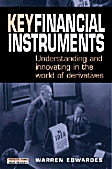
Headline: Key Financial Instruments: Understanding and innovating in the world of derivatives By Warren Edwardes
12
November 2001 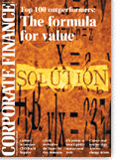 Warren
Edwardes' book Key financial instruments
reviewed by Angus Foote Editor, Corporate Finance Magazine "refreshing
.. throughout the book, Edwardes concentrates on themes and principles rather
than on pure maths as he seeks to demystify derivatives .. heavy stuff is there
too, although the author seeks to lighten it up with historical examples and
context .. appendices very useful, as they outline financial risk types and
explain the major risk management instruments and terms."
Warren
Edwardes' book Key financial instruments
reviewed by Angus Foote Editor, Corporate Finance Magazine "refreshing
.. throughout the book, Edwardes concentrates on themes and principles rather
than on pure maths as he seeks to demystify derivatives .. heavy stuff is there
too, although the author seeks to lighten it up with historical examples and
context .. appendices very useful, as they outline financial risk types and
explain the major risk management instruments and terms."
Source: Corporate Finance Date: November 2001
Readers who approach a book on derivatives filled with dread at the prospect of page after page of formulae will find Key Financial Instruments refreshing.
Throughout the book, Edwardes concentrates on themes and principles rather than on pure maths as he seeks to demystify derivatives.
The heavy stuff is there too, although the author seeks to lighten it up with historical examples and context. The section covering credit derivatives is small but fairly comprehensive.
A glance at the contents will show that there is little in the book that is written specifically for the corporate, but this is because it concentrates on general explanation rather than because it leans towards the banks and market makers.
While reading this book will not take the reader to point where he or she can immediately embark on a derivatives-based hedging strategy, the newcomer seeking to understand the basic principles which govern the derivatives markets will find it a useful starting point.
Those corporate readers who are getting to grips with derivatives for the first time will find the appendices very useful, as they outline financial risk types and explain the major risk management instruments and terms.
Edwardes’ credentials as an expert on derivatives are impressive. Currently chief executive of London-based consultancy Delphi Risk Management, he has served on the board of Charterhouse Bank as director of financial engineering and previously worked for, among others, Equitable Life and the British Government Actuary’s Department.
Key Financial Instruments is published by Pearson Education.
Delphi
Risk
Management: Delphi
 Delphi
 & Delphi
 are the Innovation, Communication & Risk Management arms of Delphi Risk
Management Limited
are the Innovation, Communication & Risk Management arms of Delphi Risk
Management Limited
If you have reached this page directly from a
search engine visit Delphi's